
By Yunusa Hamza
The 2027 general elections are here or by the corner, as we witness the ups and down within and outside the shore of the country, Jigawa State stands at a critical political crossroads.
Historically known for political stability and loyalty to dominant parties, the state is once again emerging as a strategic electoral stronghold.
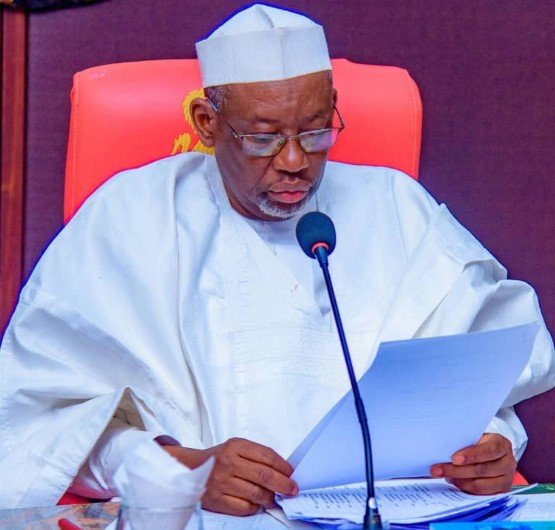
At the centre of this evolving narrative is Governor Umar Namadi fca whose leadership style and governance approach appear to be reshaping Jigawa’s political discourse beyond conventional rhetoric. Rather than relying solely on slogans and party loyalty, Governor Umar Namadi has constructed a performance-based political identity that seeks to anchor electoral legitimacy in tangible governance outcomes.
This development raises a fundamental question: Is Jigawa moving toward a new era of issue-based politics, or merely witnessing a more sophisticated form of political consolidation?
This remains a million-dollar-question to all political analysts and those that has stake in the governance and Government businesses of the New World.
Before deepening into the known rhetorics, it will be good enough to re-echo the traditional political pattern in Jigawa’s political history which has largely been characterized by continuity, elite consensus, and strong party structures.
Electoral outcomes have often reflected established power networks rather than vibrant ideological competition. Campaigns traditionally focused on personality, patronage, and party affiliation, with limited emphasis on policy substance.
This pattern created a political culture in which governance performance, though important, was rarely the central determinant of electoral success.
Consequently, political body language often outweighed accountability, and public discourse revolved more around loyalty than long-term development visions.
Those that are within the space can attest to this trajectory and political transitioning from 1993 of Governor Ali Saadu Birnin Kudu emergence under the Social Democratic Party,(SDP) to Governor Ibrahim Saminu Turaki of All People Party (APP) who clinched the baton against the popular People Democratic Party (PDP) candidate, whose party obtained majority of the LGAs, but sequentially we witness the relinquishing of Power to Sule Lamido by the then ANPP establishment and government based on political intricacies.
To keep records straight this trends hasn’t change even during the juggernautism of 2015, and what came to play then was full of political Marodanism which to date affects the biology of the state politics without clear physics or algorithms to claim ignorance, Governor Muhammad Badaru Abubakar then emerged at a sole candidate of the merger after rigorous permutation and politicking that stood for days and can easily be referred as ‘’Gumel battle’’ against all odds and arithmetic. (the rest is a story, for another day).
Mindful of not been accused of misplacing priorities and setting a precedence, the politics, politicking and politization of the Jigawa state much love political structure get mismanaged with attempt of silent political coup and displacement under the ego substitution without recourse to the rule of the game, and that cost lot of political expensive joke of the century.
While not jumping the gun,(which is a political) the Umar Namadi’s emergence, journey to governance and giant development viz social, economic, political and all available indicators which were changed drastically and dramatically to positive (emphasis mine) and had make governance an easy turn around for improve and strategic arena to/for every citizens to feel the ambiance of his cool and soft minded approach to politics, Governor Umar Danmodi as fondly refer use more carrot than stick in facing and addressing myriad challenges and blockages that cowed the system from moving, he tactfully dismantled clusterisation of policy issues and plan, and ably secured a niche for making all strata of the Jigawa state citizens benefit , partake and contribute to the bigger picture of Jigawa Projects through the instrument of implementing the content of his administration 12point agenda which are in alignment with the state plans, process and procedure.
The Governor’s well-structured State executive councils meeting on weekly basis, the unanimous agreement and broadcasting of the councils’ resolution–a multi sectoral one, the follow up, monitoring and tracking of awarded projects, the ever successfully and all-year-round, proto-type citizens engagement to all twenty seven (27) LGAs, the conduct of one-of-its’-kind-sectoral meetings with all, and relevant stakeholders x-raying the happenings with the premise of, what went well, what went wrong and what is needed to improve the situation had completely changed the governance and political narratives in the state. Governor Umar Namadi’s administration represents a noticeable departure from this tradition.
His political messaging consistently foregrounds governance outcomes including not limited to youth empowerment, social welfare, agricultural development, and institutional reform. Rather than projecting himself merely as a party loyalist, Governor Umar Namadi fcanpresents his leadership as a technocratic and developmental project and a real advocate for masses emancipator, though to those who are within the development space had witnessed his excellency’s contribution to bigger and globally accepted of governance under the umpire of systemic co-creation as postulated by the principles of Open Government Partnership—which co-chairs for almost a decade.
Those learnings and approaches have helped him swiftly and technically in shifting public attention from campaign promises to measurable actions. By emphasizing implementation over declaration, Governor Umar Namadi has cultivated an image of competence and seriousness, positioning governance itself as a political campaign tool.
In doing so, he has blurred the boundary between administration and political mobilization, making policy delivery an instrument of electoral legitimacy.
It is also in notice beyond governance that Governor Umar Namadi fca has demonstrated a sophisticated understanding of political engineering. His consolidation of party structures, encouragement of grassroots mobilization, and alignment with federal leadership reflect deliberate efforts to stabilize political dominance. These strategies have weakened opposition influence and reinforced APC’s control in the state.
However, this consolidation is not merely authoritarian or coercive; it is largely legitimized through performance narratives, consultation with those that matters most. Development projects and social programs function not only as public goods but also as political capital. Thus, governance becomes both a service to citizens and a tool for sustaining power.
It is expedient to note that his excellency’s dual function marks a new phase in Jigawa politics which defines power as no longer justified only by tradition or party loyalty, but by managed perceptions of effectiveness through reaching and touching the lives of common man.
From Gwiwa LGA of the extreme end of the North east to Gwaram LGAs there isn’t no any politically recognised ward that haven’t receive intervention, to make it home, Farin Dutse as a community and a political ward received the rejuvenation of a failed electricity line from over 16years, the construction and reclaiming of water washed areas leading to a frightened gully erosion through the provision of concrete drainages, to the construction of new schools towards addressing out of-school syndrome at both Junior Arabic Secondary school and the Fulani Community Primary school of Alagarno resulting to improve learning and teachings outcomes.
Provision of solarised/motorised borehole and reticulation of the whole water system of the entire community which stood as a test of time. It is also in record that the contract approved and awarded for the road starting from Gwaram to Farin Dutse, to Fagam with a spur to Kwanar Sagir will soon be rehabilitated and overlayed with asphalt to ease transport commotion of good and services from the whole Fagam constituency which harbours’ the popular grain and foodstuffs Haya Market.
One of the most significant outcomes of this governance-driven narrative of Governor Umar Namadi fca, is the gradual transformation of voter expectations. Many Jigawa citizens increasingly assess leadership through visible outcomes rather than symbolic promises. Infrastructure employment programs, and social interventions now form part of political evaluation, and we keenly await a shift from traditional approach to a-new-normal where the expert and digital crops will make difference in revolutionising the political dynamics with less hustles of sentiments and disenfranchisement leading to a deliberate and conscious strategic political engineering running away from the traditional rhetoric.
This piece is contributed by Yunusa Hamza (Tafidan Farin Dutse) who writes from Kofar Fada Farin Dutse Gwaram LGA Jigawa state.