
From Mika’il Tsoho, Dutse
Governor Malam Umar Namadi on Monday presided over a special interaction with Tsangaya school teachers drawn from across Jigawa State, as part of his administration’s unflinching commitment to reforming, strengthening, and modernizing the almajiri education system in Jigawa State.
This was contained in a statement signed by Hamisu Mohammed Gumel Chief Press Secretary to the Governor Government House, and made it available to news men.
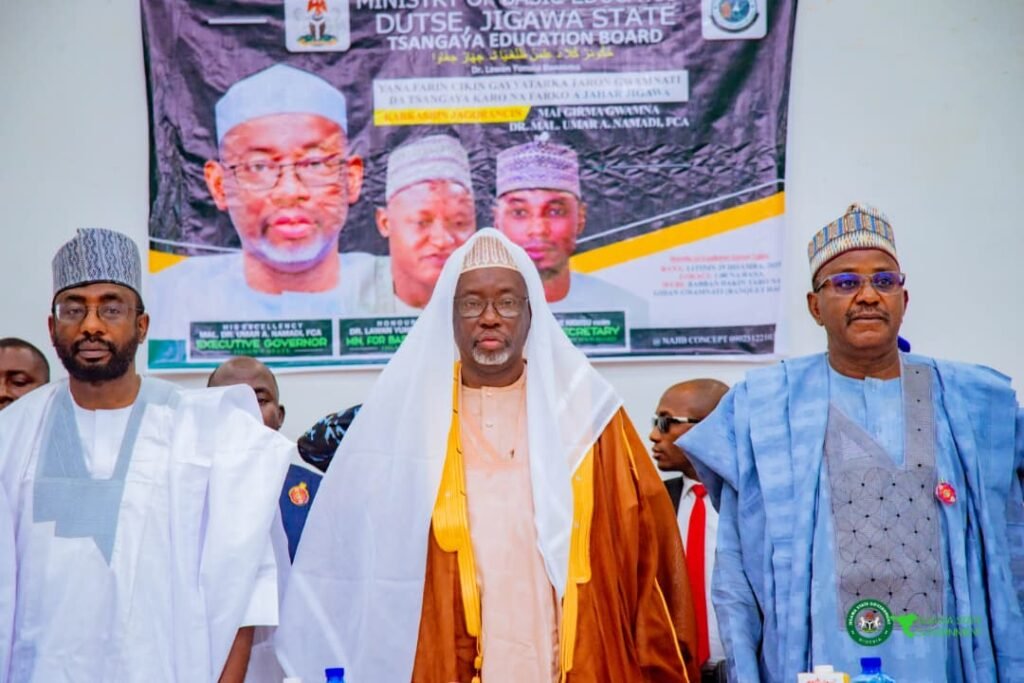
The programme, tagged “Gwamnati Da Tsangaya,” (Government Engagement with Tsangaya Schools) was organized by the Jigawa State Tsangaya Education Board as a consultative forum aimed at deepening engagement between government and key stakeholders in Qur’anic education.
The session provided a platform for Tsangaya teachers to share their experiences, challenges, and expectations, while also offering practical recommendations on improving the welfare, education, and future prospects of almajiri pupils.
Participants at the event included renowned Qur’anic reciters from various parts of the country, who attended as special guests, further underlining the national significance of Jigawa State’s Tsangaya reforms.
Speaking at the event, Governor Namadi described the interaction as historic, noting that it was the first time since the establishment of the Tsangaya Education Board that top government officials—including the governor, deputy governor, commissioners, and members of the State Assembly—were jointly engaging with Qur’anic school teachers in a structured dialogue.
“This meeting is very important to us because, as a government, we believe that Qur’anic education deserves greater attention and support than it currently receives. That is why we established this agency in this blessed state,” he said.
He disclosed that Jigawa State currently has over 4,000 Tsangaya and Qur’anic schools with more than 1.3 million pupils, a figure that exceeds the number of conventional primary schools in the state.
According to him, neglecting such a vast system would amount to a major social and developmental loss; hence, the decision to institutionalize Tsangaya education and make it a permanent component of the state’s annual budget.
“We established this agency so that Qur’anic education itself will be included in the annual budget of the Jigawa State Government. Because if you neglect 4,000 schools and abandon more than 1.3 million students without care, that is a very serious loss to society.
“I want people to understand that an almajiri is not an out-of-school child; an almajiri is in school and is also a student. That is why we resolved to improve this system of education, and with your cooperation and support, we will, God willing, restore dignity to this form of learning.”
Governor Namadi stressed that the state’s approach is to modernize almajiri education without undermining its religious and cultural foundations, explaining that Tsangaya schools in Jigawa are being transformed into integrated institutions where Qur’anic memorization, modern education, and vocational skills are taught side by side.
The governor also revealed that the state is collaborating with the National Board for Arabic and Islamic Studies (NBAIS), under which nearly 100 Qur’anic school teachers have already been trained and certified in their education, similar to what obtains in the conventional school system.
“Our goal in the Jigawa State Tsangaya Agency is that once a learner completes primary-level education, they will obtain a certificate. Likewise, at every stage of Qur’anic education, God willing, one will receive a certificate upon completion.”
“That is why, in our Tsangaya schools, we have integrated Qur’anic studies, modern education, and vocational skills in one place. Therefore, anyone who attends our Tsangaya schools in Jigawa State will acquire three things: first, they will become memorizers of the Qur’an; second, they will gain modern education; and third, they will learn a vocational skill.”
He announced that in the 2026 budget, the government plans to recruit 500 teachers for Tsangaya schools across the state, alongside phased training programmes for Qur’anic teachers and increased budgetary allocations for Tsangaya and Qur’anic schools.
In his remarks, the Executive Secretary of the Jigawa State Tsangaya Education Board, Dr. Abubakar Maje Hamisu, expressed gratitude to the Governor for his visionary leadership, outlining ongoing and completed interventions, including the establishment of modern Mega Tsangaya Schools, renovation of model Tsangaya schools, integration of modern subjects, the Almajiri Begging-Free Zone initiative, large-scale provision of learning materials, and planned expansions in 2026.
“Under the “Almajiri Begging Free Zone” programme, Almajiri children were transferred into government-owned Tsangaya schools. The programme was implemented in Dutse, Kiyawa (Shuwarin), Hadejia, Kafin Hausa, Taura (Gujungu), Ringim, Kazaure, Gumel, and Maigatari,” he stated.
“A total of 2,000 Almajiri children were enrolled—1,000 from major towns and 1,000 from other local government areas across the state.”
He reiterated the Board’s commitment to working closely with Tsangaya school teachers, communities, and development partners to ensure that Tsangaya education in Jigawa State progresses in line with contemporary standards while preserving its moral and religious essence.
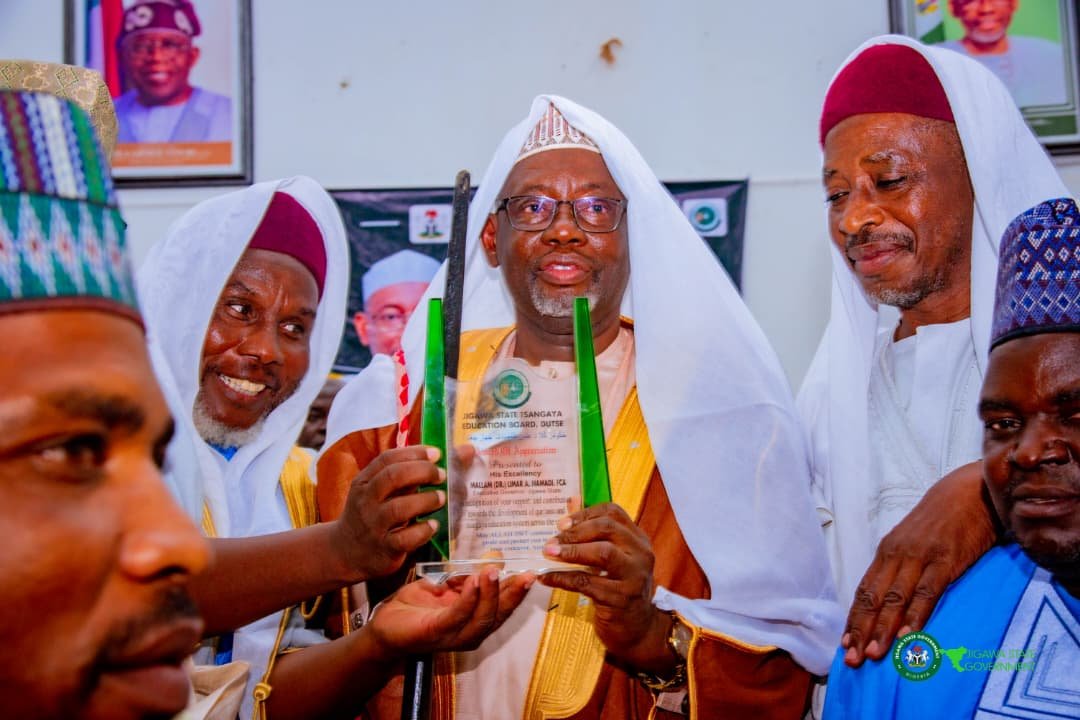
The highlight of the programme was the formal honouring of Governor Namadi as Patron of the Qur’anic Reciters Association of Nigeria, in recognition of his administration’s sustained support for Qur’anic education, religious scholarship, and the welfare of Tsangaya institutions.