
By Our Correspondent
Leaders from Nigeria’s Middle Belt have resolved not to present a presidential candidate in the 2027 general elections, opting instead to support a candidate from Southern Nigeria under the African Democratic Congress (ADC).
The decision, they said, is driven by the need to promote national balance, fairness and inclusion in the country’s political process.
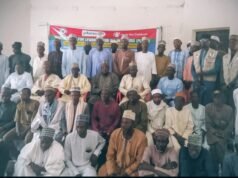
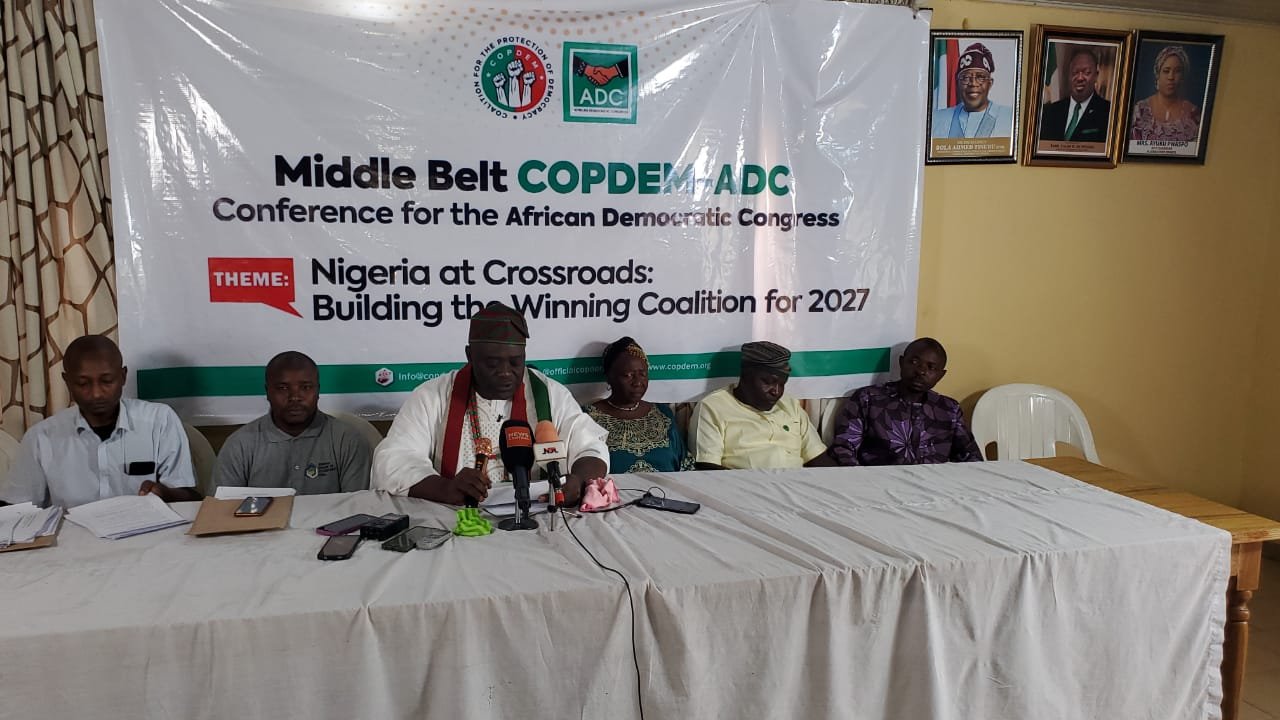
The resolution was reached on Tuesday at the COPDEN/ADC Middle Belt Strategy Conference held at the Nigeria Union of Journalists NUJ Press Centre, in Jos, Plateau State on Tuesday. The conference, themed “Nigeria at Crossroads: Building the Green Coalition for 2027,” was organised by the Coalition for the Protection of Democracy (COPDEN) in collaboration with the ADC.
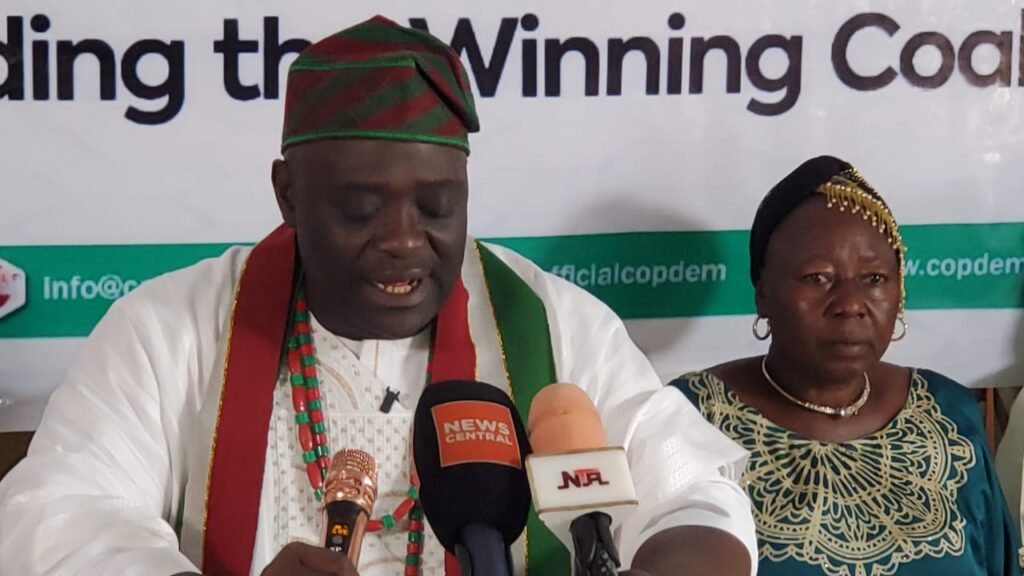
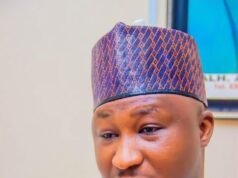
Reading the communiqué, the Coordinator of the group, Prince Pam Rwang, described the move as a deliberate and strategic effort to strengthen national cohesion ahead of the 2027 elections.
According to him, “after extensive deliberations, participants unanimously agreed that Nigerian elections are won through broad-based coalitions rather than regional dominance.”
He added that the Middle Belt occupies a critical position in Nigeria’s political landscape, serving as “a decisive electoral bridge between the North and the South.”
The conference placed strong emphasis on fairness and rotational leadership, noting that power rotation is already practised at various levels of governance across the country.
“Delegates observed that zoning and power rotation are already practised at state, local government and ward levels, and should therefore be respected at the national presidential level,” the communiqué stated.
In a unanimous position, the leaders declared that the Middle Belt would not push for the presidency in 2027.
“The Middle Belt will not seek to lead from the front. Instead, the region will position itself as a conscious, strategic and decisive political bloc that shapes national outcomes through alliances rather than sectional contestation,” the communiqué read.
The stakeholders further recommended that the ADC presidential ticket be zoned to Southern Nigeria, in line with what they described as Nigeria’s tradition of balance and inclusion.
They stressed that political arrangements built on justice and equity are more likely to gain nationwide acceptance.
“Electability depends on national acceptability and deliberate demonstration of fairness. Leadership that unites regions builds legitimacy,” the conference noted.
The leaders also reaffirmed their commitment to acting as a unifying force in Nigeria’s political space, prioritising coalition-building over personal ambition for the presidency.
Our correspondent reports that the conference attracted political stakeholders, civil society actors and democratic reform advocates from across the Middle Belt region.
Pastor Paul Isaac Audu
Represented Nasarawa State at the conference.