
By Kamil Lawal
Recent political developments in Rivers and Kano States have exposed a troubling contradiction at the heart of Nigeria’s party politics one that goes beyond personalities and speaks directly to the question of whether political parties still stand for ideas, or merely for power.
In Rivers State, Governor Siminalayi Fubara now widely regarded as aligned with the All Progressives Congress (APC) has been subjected to relentless attacks by APC supporters for refusing to submit to the political influence of his predecessor, Nyesom Wike of the Peoples Democratic Party (PDP).

His insistence on independence is framed not as leadership, but as rebellion; not as constitutional authority, but as “PDP influence.”
The narrative pushed is clear: resistance to an entrenched power bloc is cast as disloyalty, even when it comes from within or around the ruling party’s orbit.
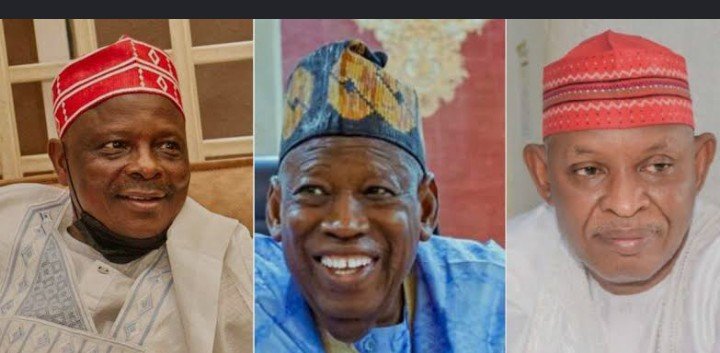
Yet, in Kano State, an entirely different standard applies. Governor Abba Kabir Yusuf, who was fiercely opposed by the APC through every stage of the electoral process right up to the Supreme Court is now warmly embraced by the same APC supporters. The reason is neither ideological convergence nor policy alignment.
It is simply that Abba is perceived to have “aligned” politically. In the process, his long-time political mentor, Senator Rabiu Musa Kwankwaso, is quietly sidelined, and yesterday’s legal and political battles are conveniently forgotten.
This contrast raises an uncomfortable but necessary question: why is independence treated as a sin in Rivers, while defection or alignments is celebrated as a virtue in Kano?
The answer appears less about principle and more about convenience.
In Rivers, a governor asserting autonomy is portrayed as a threat to established interests while In Kano, a governor adjusting political loyalties is praised as pragmatic and welcome.
Same party. Same Nigeria. Completely different moral yardsticks.
This is not merely an APC problem; it reflects a deeper, systemic flaw in Nigeria’s political culture. However, as the ruling party, the APC’s contradictions carry greater weight and consequence. When party supporters condemn independence but reward alignment without scrutiny, they reinforce the perception that ideology is secondary to control, and that loyalty to power outweighs loyalty to voters or democratic norms.
Political parties are expected to stand for something clear values, policy directions, and ideological coherence. But when today’s enemy becomes tomorrow’s hero simply because the arithmetic of power has changed, the public is left with a hollow democracy where principles are negotiable and consistency is optional.
So, when APC supporters shout “PDP influence” because Fubara resists Wike, but shout “Welcome home” when Abba distances himself from Kwankwaso, Nigerians are entitled to ask: is this politics, or pure double standards?
If loyalty to principles becomes irrelevant once one joins or aligns with power, then parties cease to be platforms for governance and become mere vehicles for survival. And when that happens, democracy itself is diminished not by opposition parties, but by the ruling class’s unwillingness to be consistent with its own claims.
Nigeria deserves a political culture where independence is not punished, defection is not blindly celebrated, and power is not the only ideology that matters.
Until then, the question will linger: do Nigerian parties stand for ideas, or just numbers and power?